Film
Boyle’s Guernica
Remember we must die
If you’re from Great Britain – and I pray that you aren’t – you will be all too familiar with sitting on a train that goes nowhere. Here you are, sitting on tracks on the rock of a dead empire, its once well-oiled mode of global imperialism now struggling to move you from Liverpool to Warrington.
Spoiler klaxon – if you haven’t seen 28 Years Later yet: stop here, watch it, and I’ll see you when you get back.
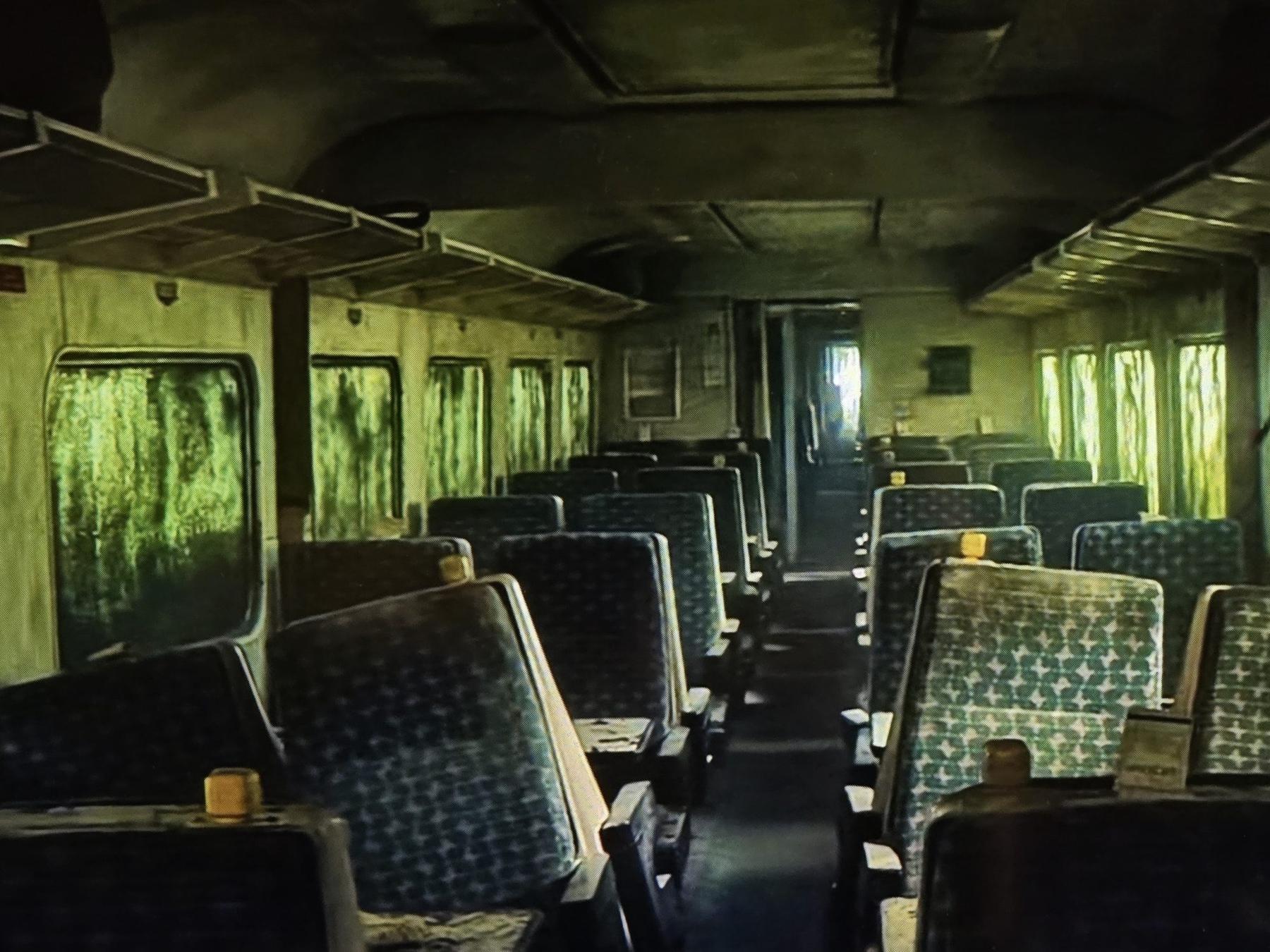
Somewhere in the middle of 28 Years Later, our protagonist Spike and his deteriorating mam Isla come upon a dilapidated train covered in moss. Their names alone signpost the exploration of islandism to come: Isla and Spike, an invocation of Spike Island, and Alex Garland’s reminder that no man is one, especially on Nu Britain.
The train is a fitting setting for the themes infecting the film: a unifier of the island’s past, present and future. A nation that delivered to the world the railway, its own infrastructure now in active decline through rampant privatisation and worsening services.
This is just one of many ways in which both writer Garland and director Danny Boyle look at the state of Britain at large under the guise of a blood and guts zombie movie. It is their Guernica, a layered tapestry for the viewer to parse out a myriad of possible comments on Brexit, the rise of fascism, individualism, decay, and naive notions of Good Old Blighty. More on Jimmy Savile later.
These undercurrents are a key that unlocks 28 Years Later, which is why it’s all the more fitting it’s helmed by the man who directed what many rose-tinted sunglass wearers consider the coronation of British identity – the 2012 London Olympics.
This moment has crystallised into a period in Britain when everything was in bloom, and the last time we all saw eye to eye as one happy, modern decathlon loving family. It does not include: David Cameron’s austerity kink, the ramping up of NHS privatisation, and Theresa May’s scapegoat war on immigrants that set us on the course we find ourselves on today, utilising the most powerful of viruses – rage. It only takes looking at the recent masked “protests” in Dover to get a sense of what Boyle is getting at about the future we might be making for ourselves.
This idea of possible futures, better and worse, is ever present. When Spike and Isla come upon the Angel of the North, Isla marvels at it and, in her delirium, is brought back to the past to tell a story about when her father explained that this beloved monument would be there for all time. By looking at it, they had “fallen into the future”, the notion of a bigger and better world where wonders exist. But this is a world where cultural identity stopped dead for the country in 2002. Where the sycamore tree that caused national outrage was never chopped down. Where Jimmy Savile was still a harmless rascal.
When the virus is loose, it sweeps through the country almost instantly, literal rage passing from one person to the next. Through this lens, the opening scene hits that much harder, and feels that much more pointed. A very British household being consumed with hysteria, room by room, as the adults infect the children – placidly watching Teletubbies only moments earlier.
In the series’ first entry, 28 Days Later, we know that this was all self-inflicted. It was we who showed the monkey rolling hatred on screens and then set it loose on ourselves, a portent of algorithmic outrage media. By the time we get to Years it’s even taken Scotland with it – bringing to mind the false promises to keep it tethered to the infected nucleus in 2014. The masochist in me likes to make outlandish connections to the real world that might not be intended to be read as such, but like I said – Guernica. Did Garland mean anything by introducing new variants of zombies that are angry bald white men bottom-feeding on worms? Surely not, but you can’t stop me thinking as much. It’s a free country? Baby?
When we meet Spike at the beginning of the film – in a wonderfully naturalistic performance by Alfie Williams – he is saying goodbye to his Power Ranger action figure, and consequently to his childhood. Once he leaves that house, he’ll never be a child again.
His journey is balanced between the dark and light of his mam and dad, Isla and Jamie (Aaron Taylor-Johnson). Jamie pulls him into the violence of adulthood; Isla, in her moments of lucidity, mothers him as the twelve year old he is. There is a key scene that underscores this idea of the world we make for kids when, camping in a derelict church, Isla softly asks Spike, “Is your dad silly with you?” She understands the importance of lightness in a world bogging itself down. That’s Boyle’s sensibility to a tee. In a bleaker than dishwater apocalypse movie he cuts to a shot of an old “You’ve been Tango’d” advert – which would have still been in the public consciousness in 2002 – just because its faded colours make the Orange Man look like a zombie. Just because it’s silly.
When Spike sets off on his first foray into the wilderness with Jamie, Boyle scores it with Taylor Holmes’ reading of the Kipling poem Boots. One of the most haunting recordings ever made, and hard to fathom it was created in 1915. His voice growing more apoplectic by the verse, it plays nicely atop a film wholly concerned with exploring the different strokes of nationalism and its hand in hand relationship with violence.
We’re told in title cards that the island has been quarantined from the rest of the world and left to fend for itself. A mutated version of what pro-Brexit isolationists sought, only now populated by a different type of Alpha influencer. The fascistic fears of overseas conquering or cultural dilution were not our undoing, it was us.
The well-meaning and ill-fated Swedish soldier, Erik, serves as an outside messenger of continuing history, something Britain is no longer participating in. He makes the connection during one of his updates to Spike on the advances of the 21st Century.
“Alphas. You make them sound like stockbrokers, or fucking wall street guys.”
It’s an interesting tidbit. Rotting monsters hopped up on chemicals running about the place unchecked while destroying communities, and zombies.
Soon after, poor Erik is dispatched by such an Alpha – the walking missile-carrier Samson – by way of an over-eager neck adjustment, and in comes Doctor Kelson (the incomparable Ralph Fiennes). A humanist antidote injected into the movie’s veins to combat the isolationism and misanthropy that has taken hold. A former NHS worker, here he is to diagnose and treat the nation’s ailments – a man who quite literally rehabilitates so-called Alpha Males. We are told by the paranoid Jamie that something is off about this man, he might even be villainous, so it’s a much needed salve when expectations are inverted and this Iodine-soaked Colonel Kurtz brings out his best bedside manner. It’s an incredible visual, his glowing silhouette marching against the verdant landscape – a radioactive beacon of human empathy.
He leads them to his bone temple and, having gone understandably insane – a little apocalypse will do that to you – his empathetic nature makes sense of something so patently morbid that he begins to win the viewer over to it too. It’s a triumph of nuance. This man is bleaching the skulls of the dead and piling them into monuments. Yet the more he speaks on it, the less macabre it all seems.
“Every skull is a set of thoughts. These sockets saw. And these jaws spoke and swallowed.”
His memento mori. The inevitability of death actualised as a bone temple, this grisly structure maintaining his grasp on his humanity.
What follows is one of Boyle’s finest hours as a director. An impeccable meditation on love and death, reckoning with both a fundamental tenet of being. Doctor Kelson coalesces the two beautifully as he walks Spike through the inevitable death of his sick mother: “Memento mori. Remember we must die… Memento amoris. Remember you must love”.
After drugging Spike, Kelson bleaches Isla's skull and hands it to her son to “find a place for her” atop the bone temple. This sequence should feel sinister, and yet in Boyle’s hands it just sings with compassion. During his lauded Olympics opening ceremony, the NHS becomes a centrepiece of the festivities celebrating Britain. Here, as he explores its decay, it’s a doctor wandering its ruins who remains one of its last representatives of humanity.
Howzat? When the roving Jimmys’ show up – bookending Spike’s goodbye to his Power Ranger figure by re-enacting the acrobatics of the tv show – they’re clad in wigs and velour tracksuits, vague approximations of the notorious pedophile. Of course they’re none-the-wiser to this real world revelation, the former knight of the realm still enjoying national treasure status in 2002 (one can only hope in this world he was pulled apart by zombies in Leeds town centre). His perception underscores the film’s wrestling with Britain’s place in history, turning the rock over to face its dark underside and acknowledge it. Savile here acts as a danger of unexamined cultural memory. Britain is frozen in place, and cannot learn what we learned. We must remember the past but we should be wary of romanticising it.
Perhaps this distinction Garland and Boyle make between the arrivals of Kelson and the Jimmys is the route to understanding the film: the difference between remembering the past and living inside it. Kelson remembers; the Jimmys preserve. One strips down the dead and builds them into something new; the other dresses itself in a Britain that no longer exists, a piece of Good Old Blighty preserved in amber. It’s precisely what nostalgia does when it refuses to reckon with history – it remembers the bunting and pictures of the Queen in the social club, but forgets what was happening behind the curtain.
The filmmakers might not see it this way, of course. But like Guernica, art absorbs the world surrounding it, and can reflect where we might be heading no matter how fantastical the destination seems. The train might not be going anywhere, but it’s certainly arrived.