Film
Review: The Social Reckoning
Sorkin's reckoning
Before my screening of Aaron Sorkin’s The Social Reckoning, the cinema aired an advert for The Molly Rose Foundation – a UK charity set up in the wake of its founder’s 14-year-old daughter’s tragic death. The father speaks directly to camera, and underlines to the audience that there is no doubt about it, Instagram helped kill his daughter. It’s a thirty second advert that is immediate and clear-eyed about the cause and effect of the topic at hand – arguably the most pressing issue of our time – and is something that in one hundred and twenty minutes Aaron Sorkin fails to dissect with the ruthlessness it deserves.
Spoilers for The Social Reckoning below.
The Social Reckoning plays out like a relatively light slideshow of pivotal moments in recent history. When a character needs reminding of their motivation, a timely conversation about cyber-bullying or vaccination conspiracies will play out in earshot with the kicker, “I saw it on Facebook”. It’s odd to see a man so famed for his writing prowess do so much telling over showing when he’s behind the camera. He appears to have misremembered what made The Social Network so effective. David Fincher’s brilliant 2010 movie, written by Sorkin, zones in on the story of two college students and their pursuit of connection, one of whom happens to be Mark Zuckerberg. It’s a focused tale of alienation, popularity, and greed that surreptitiously predicts the digital nightmares that the rest of us will be wrestling with for years to come as a result.
A good director can tell a story competently, a great director will make you tell that story to others. This is no less than what this subject matter requires. What Mark Zuckerberg and his Silicon Valley ilk have done – and continue to do – to children, democratic elections and civil society demands excoriation. Sorkin tells a story competently here, but given this is a sequel of sorts, it is nigh on impossible to not think about what Fincher would have summoned from his words; how mad we ought to be, how much we would tell others to be. We are still talking about The Social Network.
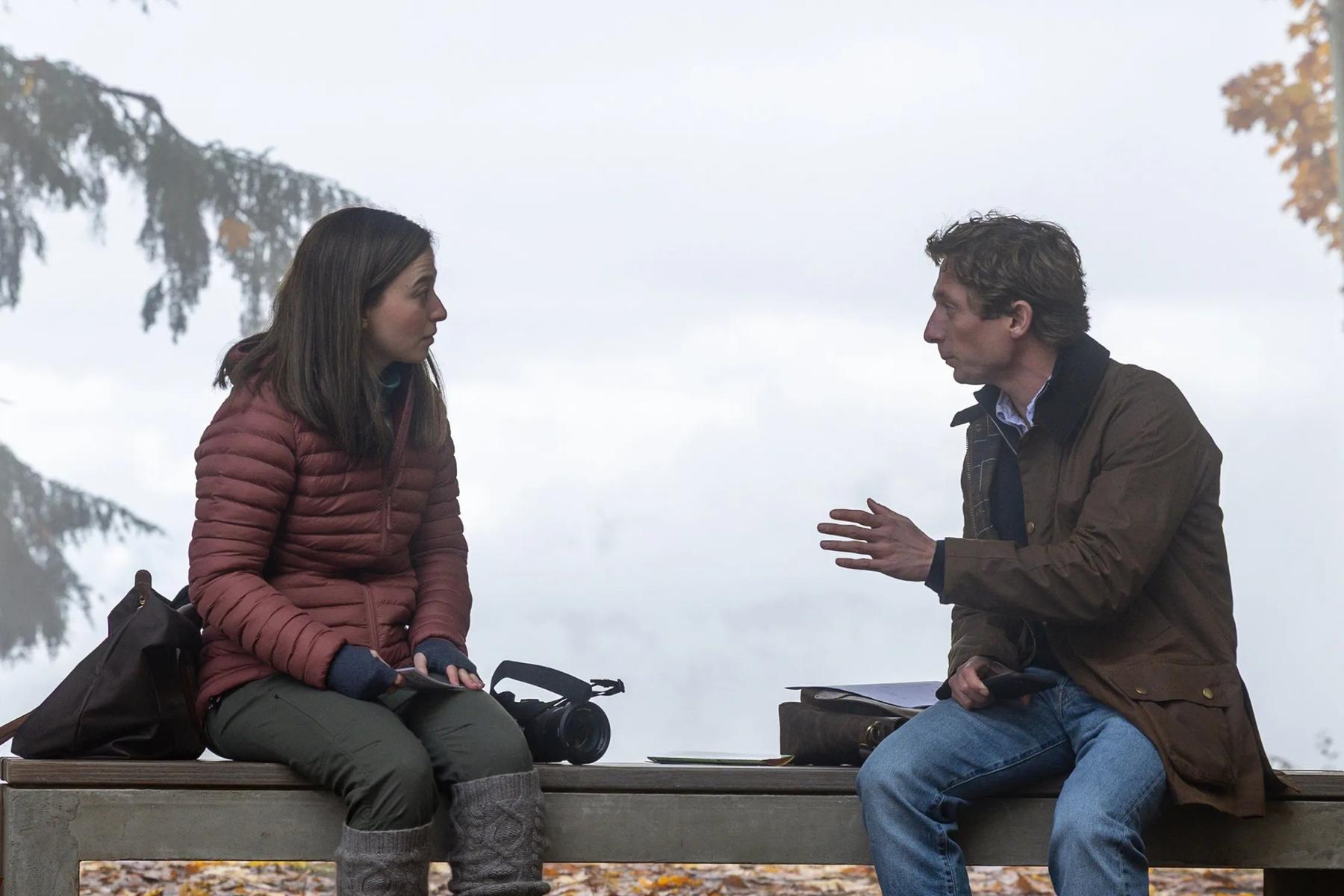
The Social Reckoning concerns itself with two key characters and their just cause of exposing the misdeeds of Facebook (now Meta). Jeremy Allen White’s reporter Jeff Horwitz, and Mikey Madison’s Facebook employee-cum-whistleblower Frances Haugen – set their sights on the target of scrutiny fairly quickly: the nefarious MSI ranking algorithm – Meaningful Social Interactions. It was an update spearheaded by Mark Zuckerberg to prioritise posts predicted to generate “meaningful” engagement – on the face of it, likes, comments, shares, but in real terms, as anyone with half a brain understands that which sells in the digital public square: inflammatory content. It is a timely story to tell, but the muted presentation never feels worthy of the blood-boiling nature of the issue.
Jeremy Strong’s Mark Zuckerberg is less a character and more a spectre, intermittently haunting the story. We never really get quite under the surface of his motivations, only his actions and monotonous mannerisms. It could be argued this might be the point, we have seen enough of Zuckerberg’s public persona to recognise a lot of truth in Strong’s portrayal, but then what good is an examination of his actions if what we get is what we know. Jesse Eisenberg’s Zuck is a wholly different person to the real world tech autocrat, but through his performance we get something to sink our teeth into.
It is an aspect that shows Sorkin’s seams at the helm. We have seen his manner of real life depictions in previous efforts – such as Sacha Baron Cohen’s bizarre portrayal of Abbie Hoffman as a libbed-out West Wing character in The Trial of the Chicago 7. The revolutionary becomes a reasonable liberal then, and now the tech autocrat becomes an affectless villain. Sorkin has a habit of sanding historical figures down to fit neatly inside his own political and dramatic vocabulary.
What also doesn’t help is his lack of visual flair as a director. For such fiery subject matter, the entire film is told in front of flat, grey backdrops, sterile hotel rooms, or a laughably Hallmark version of Puerto Rico. We are given arbitrary black-and-white scenes of Zuckerberg and the Facebook board making the costly decision of implementing the MSI algorithm. The monochromatic look is apparently supposed to invoke the solemn seriousness of grave news. But JFK this is not. When Sorkin is in control, the directorial choices he makes seem to serve no real creative purpose, only present as a vague version of what he thinks this type of movie ought to be. It is hard to see the fingerprints on his work.
It is clear Sorkin understands the gravity of the story – who has been hurt, who will be hurt, who is responsible – but he fails to establish a cinematic language that serves it. When we are presented with scenes of the outbreak of COVID in a supermarket, or the storming of the Capitol building, it just feels unfocused. The evidence has been assembled here, we know what happened. But a reckoning requires more than us knowing what happened, we need to feel the weight of it, too.
Which makes it difficult not to think again about the thirty-second advert that played before the film. A father looks directly into a camera and tells us what happened to his daughter. There is no monochrome boardroom or vague sweep of the history of Meta. There is only a human being and the consequence of what this company has built. In thirty seconds, it gave the human cost that The Social Reckoning spends two hours trying to find.