Film
Review: Whalefall
Austin Abrams has another bad day.
When I was a kid, I had a recurring nightmare wherein I was bobbing on the surface of a vast ocean, nothing around me for miles but endless blue. Then, the dark silhouette of a whale would apparate below me, creeping closer, larger, its maw opening wide as I could only wait to be consumed. Then I would wake up.
Spoilers for Whalefall below.
I have never tried to psychoanalyse it, though I am sure there is something Freudian to it. And now I got to see this nightmare actualised on the big screen. As the old adage goes: men will literally get eaten by a fucking whale instead of going to therapy.
Brian Duffield’s high-concept survival thriller asks you to suspend disbelief at its premise thanks in no small part to its sheer sincerity and a strong central performance by the continually likeable Austin Abrams – three for three now on having, to put it lightly, a bad day, following his transformational turn in both Zach Cregger’s excellent Weapons and the tight-as-a-drum Resident Evil. Whalefall serves as the next test in his leading man journey as we check the water temperature to see if we have the new everyman movie star for Gen Z. For my money, we do. Even here in clean-cut mode, he has the innate charm of the most loveable oddball at an after-party.
Reuniting Abrams with his Weapons co-star Josh Brolin, the zany concept kicks off quite briskly as his dad (Brolin), sick with cancer, ties himself down with weights and sinks to the bottom of the ocean. Resolving to find his body for closure and an initial familial sense of “I told you I could do this, dad”, Abrams’ Jay dons his scuba gear and walks into a thrashing sea. I’m no Jaques Costeau, but from the outset it is very evident to see that this is a straight-up bad idea, and our titular whale hasn’t even come into the picture.
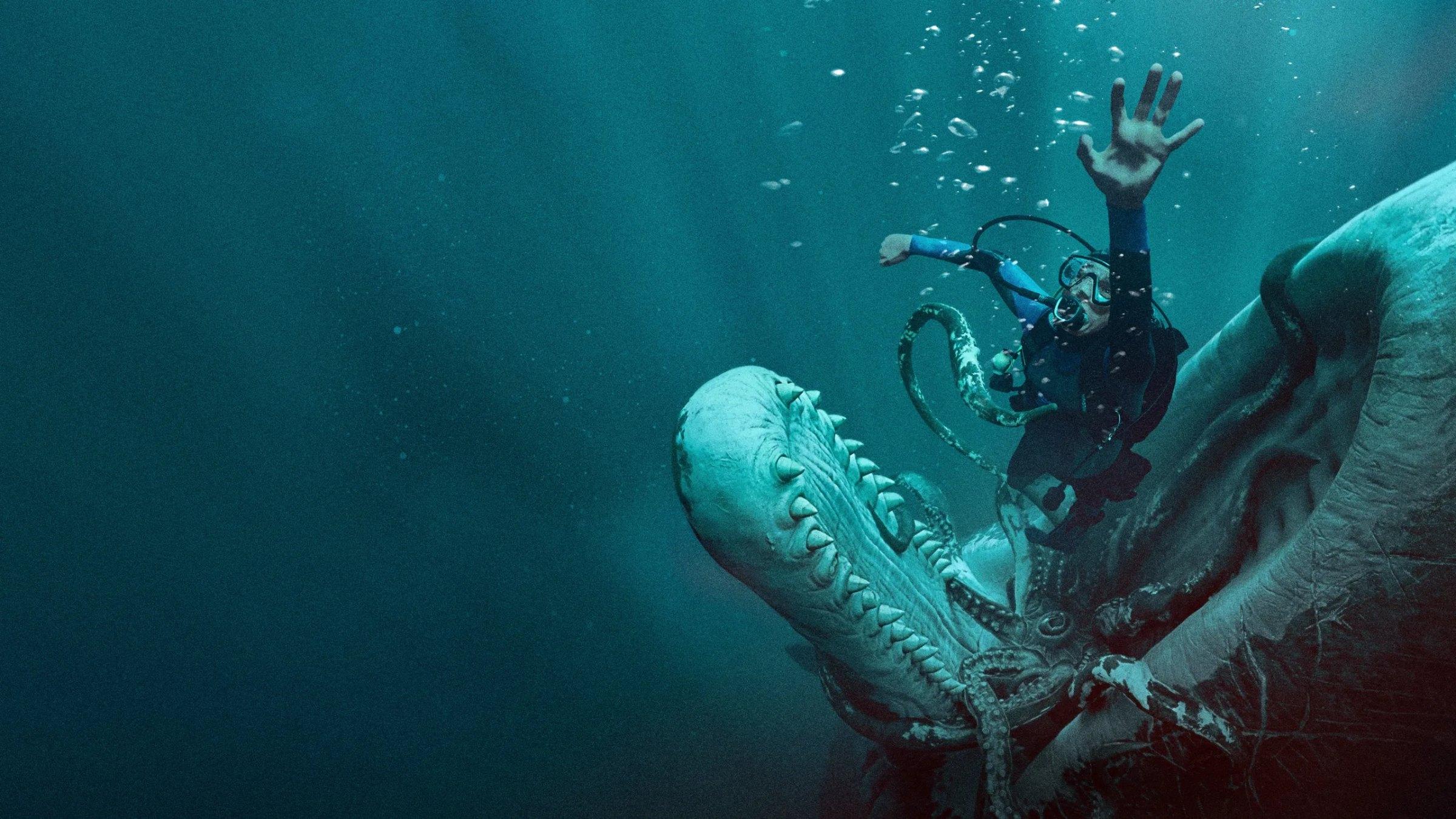
When it does arrive, Duffield and cinematographer Aaron Morton do a good job of projecting the humbling menace of being confronted with such a colossus in the deep. The sperm whale largely enjoy the reputation of the ocean’s stoner giant, a mystical being almost cosmic in its inscrutability. It is interesting to see it here as the hunter, chasing the equally uncanny giant squid. Abrams’ Jay gets tied up in tentacles, dragged and battered as the two titans duke it out, until he is inevitably gulped down like Jonah. There have been a slew of shark movies this year and so it is refreshing to see a different angle on dangers outside of cinema’s favourite sea-villain.
As the claustrophobic nightmare plays out, the story is interspersed with flashbacks of his aggravating relationship with his dad, and this device is how we learn more about Jay outside of the whale. These scenes are sometimes overly sugary, though we do get nice juxtapositions of the dad everyone else sees and the dad you might know. To the townspeople, Brolin is a seasoned pro and hero who saved lives in his stint as a diver and whale watcher. But even though he’s fatherly to strangers and a bit of a prick to Jay, ultimately he is still his dad, and he’s going to find his body.
What makes the bananas nature of the story work is that it is told as if it is a true story – Duffield presents things with the utmost sincerity which helps to lock in to Jay’s plight as he MacGuyvers his way out of the belly of the beast. He fights the half-digesting squid, and retrieves its beak to use as a claw. In a genuinely touching sequence he retrieves a swallowed jellyfish to use its bioluminescence as a torch, speaking softly to it, begging it not to “fall asleep” and plunge him back into darkness. There is also a novel aspect to a body horror happening to the protagonist’s body (digestive acids, squid beak stabbings, pressurised nosebleeds) while he himself is inside a bigger body going through its own traumas.
In a rather psychedelic development, as Jay falls deeper into panic, madness and hopelessness, his father and the whale become one. We are given more context into his father’s stern nature with him, essentially prepping him for the dangerous situations life might throw at him – like being eaten by a whale. It’s an outdated and distant form of masculine love, but a form of love all the same. In that sense, the film’s two halves collapse into one: the whale becomes this enormous physical manifestation of a father who has always loomed over Jay, capable of both hurting him and teaching him how to survive. To escape its body is also, in some way, to escape his father’s shadow.
Jay speaks to his dad through the whale, and the flashbacks become its voice, guiding him out of itself. Like Melville, Duffield is getting at the symbolic power of a whale – something so grand and unknowable that a man can pour whatever it is he’s chasing into it. Here it is the manifestation of Jay’s relationship with his father, and their reconciliation after his death.
The flicking between the whale-oriented action and Hallmark-esque family drama flashbacks can feel a bit like channel-hopping at points, though this is a perfectly effective thriller that treats its madcap biblical predicament with enough seriousness that it works quite well. Beneath the survival mechanics is a strange little story about the things fathers leave inside their sons, and what has to be carried after they’re gone. As for me, the film has successfully resurrected a childhood nightmare I’d managed to keep dormant for the better part of twenty-five years.